
Nobody Prepared Us for This Part of Parenting
On raising children in the age of AI — from a mother who works inside it and still doesn't have it figured out.

My son is six. He has never known a home without AI.
Since he could form sentences, he has been giving commands to Alexa — lights, TV, music, questions about dinosaurs at 7am. He doesn’t think of it as technology. He thinks of it as how the world works. Recently he asked me to ask my phone who was the first person to be born on Earth. Not to look it up. To ask it. As if the phone was a person in the room.
I work in AI. Fifteen years across Microsoft, VMware, Broadcom, and now Cisco. I think about this technology every single working day. And yet there is no version of my professional life that occupies my mind the way this question does:
What am I actually preparing him for?
The Map We Were Given No Longer Fits
The advice most of us received — work hard, develop a marketable skill, build a stable career — points almost directly at the roles most exposed to AI disruption in the next decade. Law, finance, medicine, writing, analysis, software engineering. The careers we have collectively decided represent success are precisely the ones where AI is already performing at or near human level, and improving faster than most people realise.
I am not writing this to frighten you. I’m writing it because parents deserve to make decisions based on what is actually coming, not on assumptions inherited from a world that is already changing beneath our feet.
The question isn’t whether our children will grow up with AI. They already are. The question is whether we are intentional enough about what we are building in them alongside it.
We are preparing our children for a world being rebuilt in real time. The map we were handed no longer matches the territory.
What Keeps Me Up at Night
It’s not the career question that worries me most. It’s something quieter.
My son lives in a world where any question he has will be answered instantly, and with confidence, by a voice in the room. He may never have to sit with not knowing. He may never develop the tolerance for uncertainty that comes from searching, wondering, getting it wrong, and trying again. That capacity — to stay with a hard question without immediately outsourcing it — is the foundation of judgment. And judgment is exactly what will matter most in a world where AI can generate a plausible answer to almost anything.
I also worry about what happens to empathy and human connection in a generation growing up with AI companions available as an easier alternative to the messier, harder, more rewarding work of real relationships. We are already seeing AI systems marketed to children as endlessly patient, endlessly available, endlessly affirming. In the short term that sounds appealing. In the long term, I wonder what it does to a child’s capacity for the friction that genuine intimacy requires.
These are not hypothetical concerns. They are already present, in quiet ways, in every home where a child reaches for a device instead of sitting with a question — or a feeling — long enough to work through it themselves.
What I’m Trying to Do — and Mostly Failing At
I want to be honest here, because I have no interest in writing the version of this where I have it all figured out. I don’t.
I know my son needs to practice being bored. That boredom is where imagination lives, where children learn to generate their own thoughts rather than consume someone else’s. And yet — getting a six-year-old to sit in boredom without immediately solving it for him is one of the hardest things I face as a parent. I don’t always manage it. Some days the iPad or Nintendo Switch wins.
I know he needs deep, unmediated time with other humans — the kind where he has to navigate conflict, share, wait, lose, and repair. I know he needs time in his body, in nature, making things slowly with his hands. I know he needs to hear me say “I don’t know, what do you think?” more than he hears me ask the phone.
I know all of this. And I fall short of it regularly.
What I’ve come to believe is that the goal isn’t perfection. It’s intention. It’s noticing when I’m taking the easy path — handing him a screen, answering before he’s had a chance to wonder — and asking myself whether that choice is serving him or just making the next ten minutes easier for me. Sometimes the answer is uncomfortable.
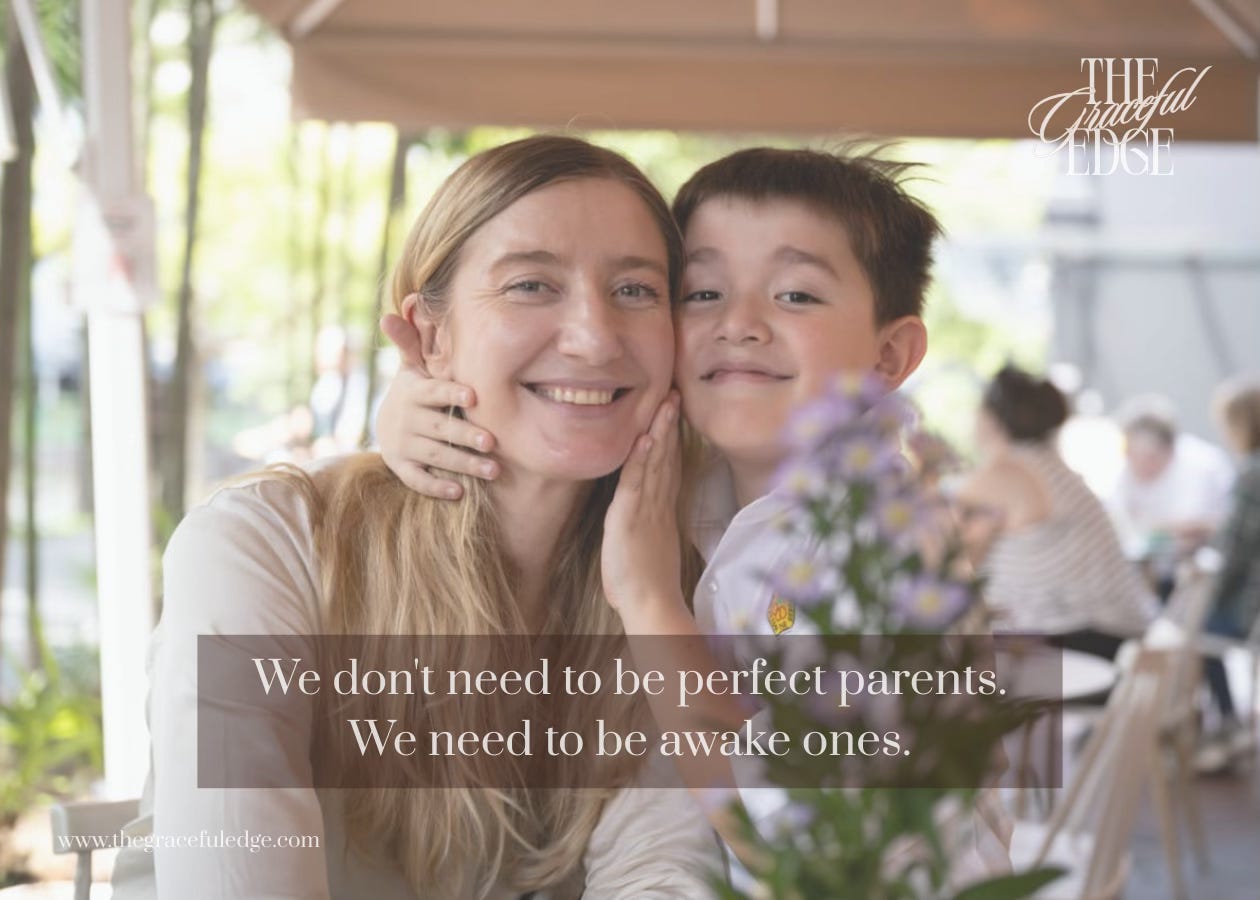
We don’t need to be perfect parents. We need to be awake ones.
The Conversation I Want to Have With You
I’ve spent a lot of time thinking about what capacities will matter most for the generation growing up now. Not specific careers or skills — those will shift too fast to predict — but the deeper human qualities that no AI will replicate: the ability to think independently, to relate genuinely, to create something that is truly their own, to know who they are when the world is moving fast around them.
Building those things is slow, imperfect, daily work. It looks like putting the phone down at dinner even when you don’t want to. Like letting him struggle with something instead of stepping in. Like choosing boredom over convenience, even when he’s furious about it. Like being honest with yourself about how often you choose the easier thing.
I don’t have a clean framework for this yet. I’m building it in real time, the same as you.
So I’m asking: what are you thinking about as AI reshapes the world your children are growing into? What are you trying? What are you finding hardest? Hit reply — I read every single one, and I’d rather think through this together than pretend I’ve got the answers.
If this resonated, share it with a parent in your life asking the same questions. The conversation starts with us.
Join the conversation every week in The Graceful Edge, where I write about leading boldly, living fully, and staying human in the age of AI. Subscribe below — it’s free!