
My executive coach gave me a simple task this week. Spend one hour in the evening doing nothing. Lie on the sofa, let the mind wander, just be.
I lasted approximately four minutes before I remembered that I had been meaning to clean my closet for months.
I don’t remember making the decision to get up. There was no moment where I thought that cleaning the closet sounds more appealing than this. Two hours later I was folding things, reorganising shelves, feeling the quiet satisfaction of visible progress. Only when I finally stopped did I realise what had happened. I hadn’t chosen productivity over rest. My nervous system had chosen it for me, so quickly and so completely that my conscious mind arrived late to the scene, looked around, and found itself holding a pile of neatly folded clothes.
I had failed the task so thoroughly I hadn’t even noticed I was failing it.
My coach and I have been exploring the balance of masculine and feminine energy — two modes of operating that exist in all of us, regardless of the gender.
Masculine energy is what most high-performing leaders, men and women, live in almost exclusively. Goal-setting, problem-solving, discipline, accomplishment, control, always moving toward the next thing. I am very fluent in this language. I have spoken it for most of my adult life and it has built everything I have.
Feminine energy is something quieter and harder to hold. Trusting, accepting, receiving, following rather than forcing, being rather than doing. Present rather than productive. I understand this intellectually, but in my body it is a different story entirely.
When I try to operate from that quieter place, a voice arrives almost immediately. It asks, persistently and without much warmth: are you sure you’re doing enough? It questions my intuition before I’ve had a chance to follow it. On good days I can recognise that voice for what it is and set it aside. On other days it is louder than my own knowing and I follow it back to productivity before I’ve even realised I’ve moved. Back to the closet. Back to the list. Back to the familiar feeling of output as proof that I am useful, present, worthy of the space I’m taking up.
It shows up with people too, in ways I find harder to admit. When someone I lead is heading toward a mistake I can already see coming, something in me wants to step in to prevent it, or simply to do the thing myself because I know I could do it faster and better. I tell myself this is efficiency. Sometimes it even is. But if I’m honest, it’s not always about efficiency. Sometimes I step in because I find it genuinely difficult to watch someone struggle toward something I could hand them in five minutes.
According to my coach, this imbalance is not just a wellbeing issue. It is a performance issue. Energy spent forcing things through sheer discipline and control is energy that cannot be replenished. And leaders who operate exclusively from force, however impressive the results in the short term, are quietly running themselves toward empty.
When I try to understand where my own imbalance comes from, I don’t have to look far.
As far back as I can remember, I was a quiet child. Independent, accommodating, careful not to take up too much space or disturb the adults around me. And then at sixteen I left home, moved to the United States as an exchange student, and went to live with a family I had never met. I navigated a language and a culture that weren’t mine, with no safety net underneath me and no one to call if things became too hard.
I learned very quickly that the only reliable thing in the world was my own capability. So I built around that. I made myself someone who didn’t need to be carried, who solved problems rather than sat with them, who moved forward because standing still felt indistinguishable from being unsafe. That adaptation served me well at sixteen. I am forty-two years old now and my nervous system still hasn’t received the update.
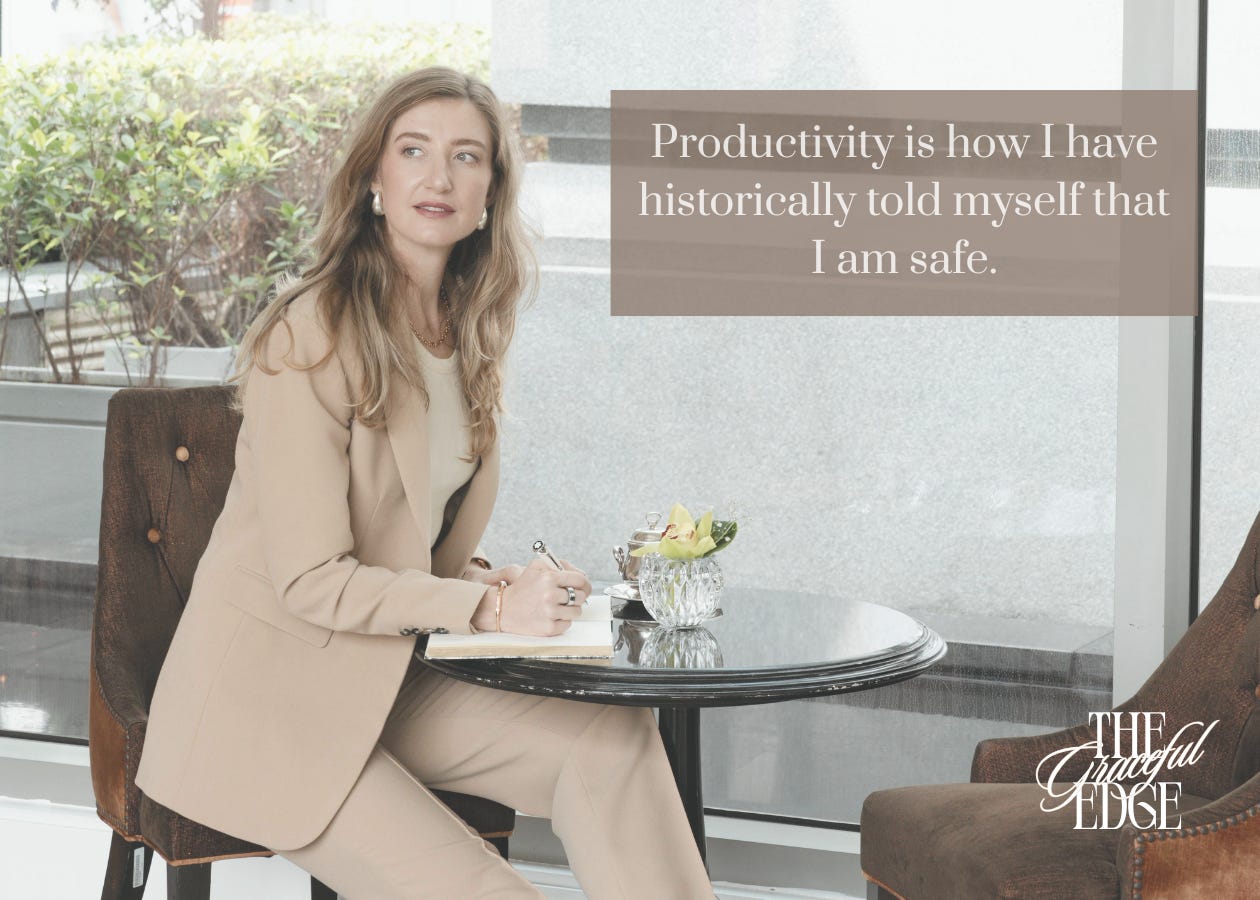
The closet didn’t clean itself because I lack discipline. It cleaned itself because somewhere deep in my wiring, stillness has always carried the faint signal of danger. Productivity is how I have historically told myself that I am safe.
My coach mentioned a book recently Power vs. Force by David Hawkins. I haven’t read it yet, and I think the honest thing is to say when something reaches you secondhand. But one idea from it gave me an aha moment:
Force requires constant energy input to sustain itself. Power is self-sustaining. It doesn’t exhaust itself pushing against the world. It simply moves through it, the way water moves, finding the path rather than demanding one.
I sat with that and thought about the last twenty years. The discipline, the systems, the sheer effortful will required to maintain the level of output I’ve held as my baseline. I had always called that strength. And perhaps it was. But force, by definition, depletes. The qualities I have been quietly treating as optional — acceptance, trust, receptivity, the willingness to receive rather than always produce — are the condition that makes sustainable achievement and the sense of fulfilment possible.
I am only beginning to understand the difference in my body rather than just my head. That is slower work than I would like. It is also, I suspect, the only kind that lasts.
I am going to try the one hour again this week. No closet. No book that quietly becomes productive. No useful task dressed up as rest. Just the sofa, the discomfort, and whatever arrives when I finally stop filling the space with output.
I’ll report back.
The question I’m leaving with you:
When did you decide that your value to the people around you depended entirely on what you could do for them?
If you recognised yourself anywhere in this piece, always busy doing something, having the voice asking if you're doing enough, or being a younger self who decided self-sufficiency was the safest bet, then you're exactly who Graceful Edge is written for. Subscribe below to get it every week, directly to your inbox.
And if someone in your life is running on force when they could be finding their power, share this with them. Sometimes the most useful thing we can do for the people we lead is hand them the words for what they're already feeling.
So beautifully written and expressed dear Elena. Thank you for being the voice for this work and helping all others who have the same struggles as you <3