
The Biology of Belonging and Why Leaders Need a Tribe to Truly Thrive
Discover how deep friendships and a sense of belonging are the most effective longevity tools for leaders who want to improve their health and performance without relying solely on biohacking.

Last week I celebrated my personal new year, another year around the sun.
After a full working day and a quiet dinner with my family at home, I went out to celebrate with my Circle of Ten — a group of nine women plus myself — my Inner Circle.
Being an expat in Singapore means this circle is a living, breathing thing. Every year, the "expat flux" claims someone; they relocate, a seat opens up, and we have to be intentional about who we invite into that sacred space. This year, we brought in someone new, and as we sat there sharing my "birthday intentions," it hit me.
For the last decade, I’ve been obsessed with the mechanics of high performance. But this year, I’m pivoting to the biology of belonging.
The Longevity Lie
We’ve been sold a very specific version of longevity lately. It’s high-tech, high-cost, and mostly solitary. It’s all about the “perfect stack”: the peptides, the NAD+ drips, the cold plunges, and the “clean” plasma.
You can be the world’s most disciplined biohacker, but if you are lonely, you are still biologically “leaking” vitality.
The data is actually quite beautiful in its simplicity. The Harvard Study of Adult Development, the longest study on happiness ever conducted, found that the single greatest predictor of how healthy we are in our 80s isn’t our cholesterol levels or our genes. It’s the quality of our relationships.
A high-functioning Tribe is a better “supplement” than anything you can find in a lab. It regulates your cortisol, calms your nervous system, and literally tells your cells that it’s safe to keep regenerating. Loneliness, on the other hand, is a slow-motion biological emergency.

The “Mirror” Philosophy
Someone asked me at dinner: “How this group come along? Why do we keep showing up for each other?”
I realized it’s because of the mirror effect. I don’t just like my friends because they are beautiful, smart, creative and fun. I like them because I like the version of me that reflects in them.
In the high-pressure world of Big Tech, the mirrors I usually look into reflect “The Executive,” “The Strategist,” or “The High-Performer.” Those mirrors are useful, but they’re incomplete. My Inner Circle reflects the “Human”, the one who is messy, who has big questions, and who sometimes forgets her own strength and doubts her potential.
To get that kind of reflection, you have to pay the vulnerability tax. You can’t see your true self in a mirror if you’re wearing a mask. Deep friendship in the second half of life requires you to drop the “I’ve got it all figured out” act. It’s the shift from having acquaintances (who know what you do) to having friends (who know who you are).
Single Point of Failure
In the tech world, we are obsessed with uptime. We build redundancy into every server and every line of code because we know that a single point of failure is a disaster waiting to happen. Yet, as leaders, we often leave our own lives dangerously un-backed-up. We have the career, the immediate family, and... that’s it.
If your only mirrors are the people who report to you or the people who live with you, your system is at risk.
Isolation breeds a subtle kind of myopia. Without a Tribe to challenge the parts of you that never show up in a boardroom, your perspective shrinks. You start to believe your own hype or, worse, succumb to your own unexamined doubts.
We’ve been conditioned to see friendship as a luxury—the “leisure” we indulge in only if there’s time left over after the “real” work is done. But that is the “busy” trap.
Your Inner Circle isn’t a distraction from your mission, it is the biological and psychological ballast that keeps you upright when the market gets choppy. A leader without a Tribe isn’t just lonely; they are strategically fragile. A connected leader is a resilient leader.
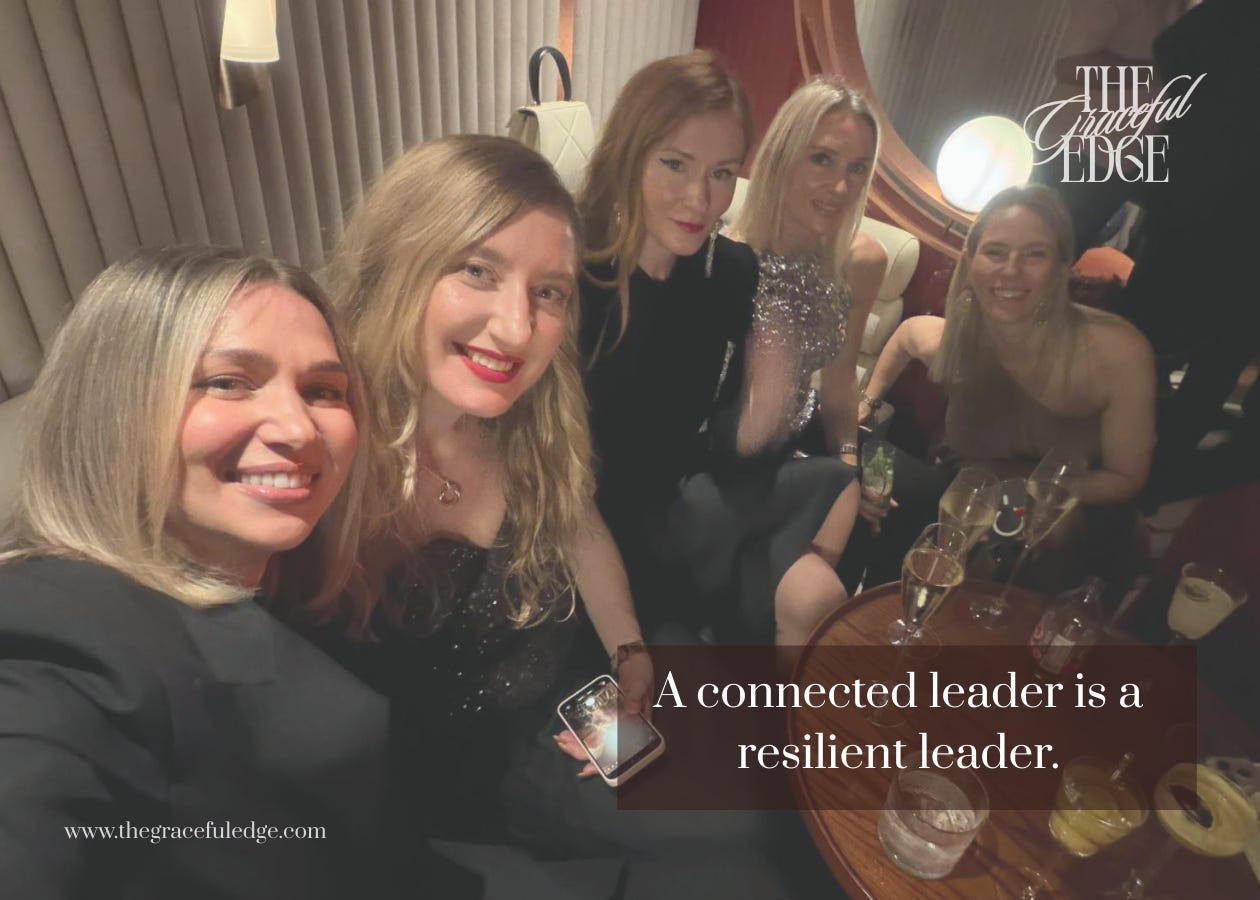
My Intentions for This Year
My life is a circus of family, a Big Tech career, and numerous hobbies. My default setting is “Go.” But for this next trip around the sun, my goal is to stop treating my friends like a “nice-to-have” and start treating them as the non-negotiable anchor for everything else I build.
Because at the end of the day, no one remembers the KPIs you hit. They remember the person you were when you sat at their table.
A Reflection Moment:
When was the last time you showed up to a dinner without your “Leadership Mask” on?
If your Tribe has become just a Network, it’s time to re-calibrate. Your cells, and your team, will thank you for it.
If you found these insights valuable, please share this article with your tribe and your network.
For more strategies on growth, leadership, and innovation, subscribe to my weekly letter, The Graceful Edge, where ambitious leaders gain a competitive advantage.