
The Holiday Hangover Nobody Talks About
How post-holiday re-entry affects your nervous system, sleep, and leadership performance and what to do about it

I came back from a week in Vietnam and walked straight into a full week.
By Monday morning I was in back-to-back meetings and by nights I was on calls until midnight because my leadership offsite ran on the US time. By Wednesday I decided to cancel all my workouts for the rest of the week, because my body needed the sleep more than the movement, and I knew it.
My Oura ring confirmed what I already felt. HRV down. Stress maxed through the day. Zero recovery windows. The data wasn’t telling me anything new. It was just making it harder to pretend that I was doing fine.
This is what nobody warned me about — the post-holiday re-entry.
Body Doesn’t Get Calendar Invites
There is a gap between how your calendar switches and how your body switches. They are not the same speed.
After a week of genuine rest, restful sleep and slow mornings, my nervous system had actually started to settle. Cortisol found a lower level. The low-grade vigilance that I didn’t even notice, lifted. I felt like myself in a way I hadn’t in months.
Then Sunday night arrived. I opened my inbox and my workweek schedule loaded…
Something in me that had just started to believe it was safe got the message that it was wrong.
The whiplash from that is real. I’ve read the research on post-holiday adaptation, how the benefits can erode within days, not weeks, when re-entry is abrupt. Even though I knew that I wasn’t ready for how it felt in my body.
What Made It Worse Than Usual
Three things compounded the re-entry this time.
The 3-days (nights in my case) offsite ran on the US time, which meant I was operating on a completely different circadian rhythm to my environment for most of the week. Sleep scientists call this social jetlag. It feels like actual jetlag, slow thinking, lower patience, decisions made in a blur state. The problem is that sleep deprivation also impairs your ability to notice how impaired you are. So you keep going.
By midweek I had three nights of broken sleep and an accumulated sleep debt. I was in a high-stakes leadership environment where I needed to be sharp. I was doing my best running on reserves. I don’t think my best that week was what it normally is.
The thing that surprised me the most was the identity wobble. I noticed I felt slower than my team. Not dramatically, nobody else would have seen it (I hope), but I felt it. And in a sales environment where pace and energy are visible, that gap registered somewhere in me as a question: had the holiday somehow softened me? Was the version of me sipping coconut water on the beach the same version required on a leadership call at 11pm?
It was a strange thing to catch myself asking. And probably a sign of how my body was lagging.
What Actually Helped
When I had to choose between an evening workout and sleep, I chose sleep. That was right. Exercise is a stressor. It’s useful when your system can absorb it, counterproductive when it’s already overloaded. The gym would be there the following week.
My morning tea practice — fifteen minutes, no phone, nothing to produce — didn’t fix anything physiologically, but it gave a moment of stillness that helped me to feel more centred and grounded. One small moment each day where my nervous system got the signal that not everything was an emergency. That signal matters more than it sounds when everything else is.
I shared with a couple of colleagues that I was in re-entry mode and not feeling my best. It wasn’t an excuse, my output was fine, but naming it out loud, rather than performing a version of myself I didn’t quite feel, took a weight off. There is energy in honesty that isn’t available in pretending.
If I could change one thing next time: don’t schedule anything high-stakes in the first two days back. Just two days to sleep in your own bed, get adjusted to a new timezone, have slower mornings isn’t a luxury. It’s a basic maintenance.
The Thing I Keep Coming Back To
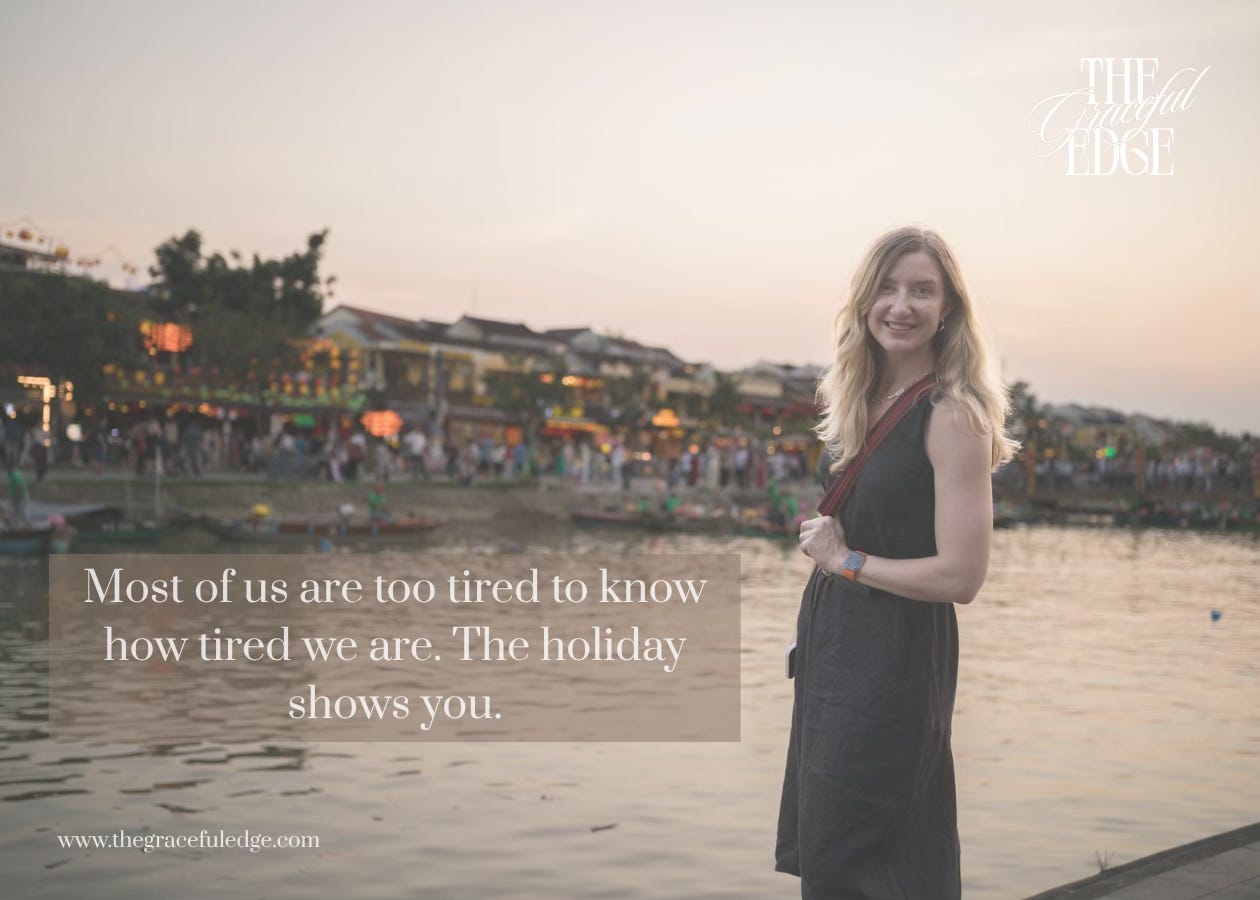
Most of us are too tired to know how tired we are. The holiday shows you.
Your system actually recovered. And now it is showing you, very clearly, the distance between how you were living before the holiday and how your body actually wants to operate.
Most of the time we are too depleted and distracted to feel that gap. The holiday reveals it.
I came home from Vietnam with cleaner thinking and a question I hadn’t been still enough to ask before I left. Whether the pace I’m returning to is one I have consciously chosen, or one I have simply inherited because I’ve never stopped long enough to look at it.
I don’t have a clean answer. But Monday morning, when the week is right in front of you and the inbox is already moving, is actually a good time to ask it.
If this landed, share it with someone who’s about to return from a holiday and has no idea what’s coming.
For more strategies on vitality, growth, leadership, and innovation, subscribe to my weekly letter, The Graceful Edge, where ambitious leaders gain a competitive advantage.