
The Quiet System Running Your Performance
What the gut-brain connection means for ambitious leaders and why standard tests miss it

Last December, a viral infection knocked me flat over Christmas and kept me there for three weeks. By January I was back to my usual routine, three strength sessions a week, 10,000 steps a day, clean eating, and yet I kept gaining weight, five kilograms over two months despite doing everything I knew to do. What was harder to name was something else happening at the same time. My mood had gone quiet in a way I couldn’t explain. Things in my life were genuinely good, and I could see that clearly, but somewhere between knowing it and feeling it, the signal was getting lost.
My first hypothesis was hormonal, a reasonable assumption given my age, so I ran the tests. My hormones were fine. That answer, while reassuring on one level, left the larger question open, and I’ve spent enough years in business to know that “not this” is not the same as an answer. So I went deeper, running a comprehensive hormonal panel, a gut microbiome test, and a food sensitivity assessment. A month later, when the results came back, four months of seemingly unrelated symptoms suddenly resolved into a single explanation. Everything traced back to my gut.
I’m sharing what I found not because my case is unusual, but because it isn’t. Most high-performing leaders are walking around with a gut system under significant stress, managing the downstream symptoms without ever identifying the source. What follows is what the science says about why that happens, and what you can do about it.

Your gut is not just a digestive organ
Most people’s mental model of the gut is fairly simple: it’s where food goes, and digestion happens. The reality is considerably more interesting. The gut contains roughly 100 million neurons, more than the entire spinal cord. It produces around 90% of the body’s serotonin, the neurotransmitter most closely associated with mood stability and a sense of wellbeing. It also houses approximately 70% of the immune system, which means that what happens in your digestive tract has a direct bearing on how well your body responds to illness, inflammation, and stress.
The gut communicates with the brain through the vagus nerve, a long bidirectional pathway running from the brainstem through the heart and lungs and into the abdomen. What surprises most people when they first encounter this is the direction of traffic. Around 80% of the information travelling the vagus nerve moves from gut to brain, not the other way around, which means the gut is not simply responding to your emotional state, in many cases, it is actively shaping it.
When the gut microbiome, the vast ecosystem of bacteria and other microorganisms living in your digestive tract, is in good balance, this entire system runs quietly and effectively in the background. When that balance is disrupted, the effects can appear almost anywhere: in your mood, your energy levels, your immune resilience, your capacity to regulate stress, your ability to maintain a healthy weight, and the quality of your sleep.
What dysbiosis actually does to a high performer
Dysbiosis is the clinical term for a microbiome that has fallen out of balance, where harmful or opportunistic organisms have grown beyond healthy levels, and the beneficial bacteria that protect the gut lining, regulate inflammation, and support neurotransmitter production have been crowded out.
When harmful bacteria overgrow, they produce compounds that increase intestinal permeability, known as “leaky gut,” allowing fragments of bacteria and partially digested food particles to pass into the bloodstream. The immune system registers this as a chronic low-grade threat and responds accordingly, keeping itself in a state of sustained alert and driving up systemic inflammation over time.
That inflammatory state reaches the brain through several pathways, and the consequences for a high-performing leader are significant. Gut-derived inflammation has been linked to shifts in mood regulation, reduced cognitive sharpness, and disruption of healthy cortisol patterns. When cortisol production is dysregulated, the downstream effects include poor sleep quality, increased fat storage particularly around the midsection, and a blunting of the emotional responsiveness that makes people both effective leaders and fully present human beings.
Simply saying, if your gut microbiome is significantly dysbiotic, your cortisol is very likely dysregulated as well, and you will feel the consequences in your energy, your body composition, and your mood regardless of how consistently you exercise or how cleanly you eat.
Why standard tests miss this
A standard blood panel is a valuable tool, but it was designed to identify disease, not to assess the quality of your function. It tells you whether your markers fall within a reference range built around average population health, which is a meaningfully different question from whether your body is operating at the level your life requires.
What a standard panel will not show you is the composition of your gut microbiome, whether your cortisol rhythm is following a healthy arc across the day and night, or which specific foods may be generating low-grade immune responses in your body. These are precisely the variables that matter most when the symptoms someone is experiencing don’t fit a neat diagnostic category.
This is the practical difference between symptom management and root cause investigation. Symptom management addresses the output: mood is flat, so increase exercise; weight is rising, so reduce calories further; energy is low, so tighten up sleep hygiene. None of these responses are wrong, but they are all operating at the level of the signal rather than the source, adjusting dials on the dashboard while leaving the engine uninspected. Root cause investigation starts from a different place, asking what is actually generating these signals, and recognising that a different question requires a different set of tools.
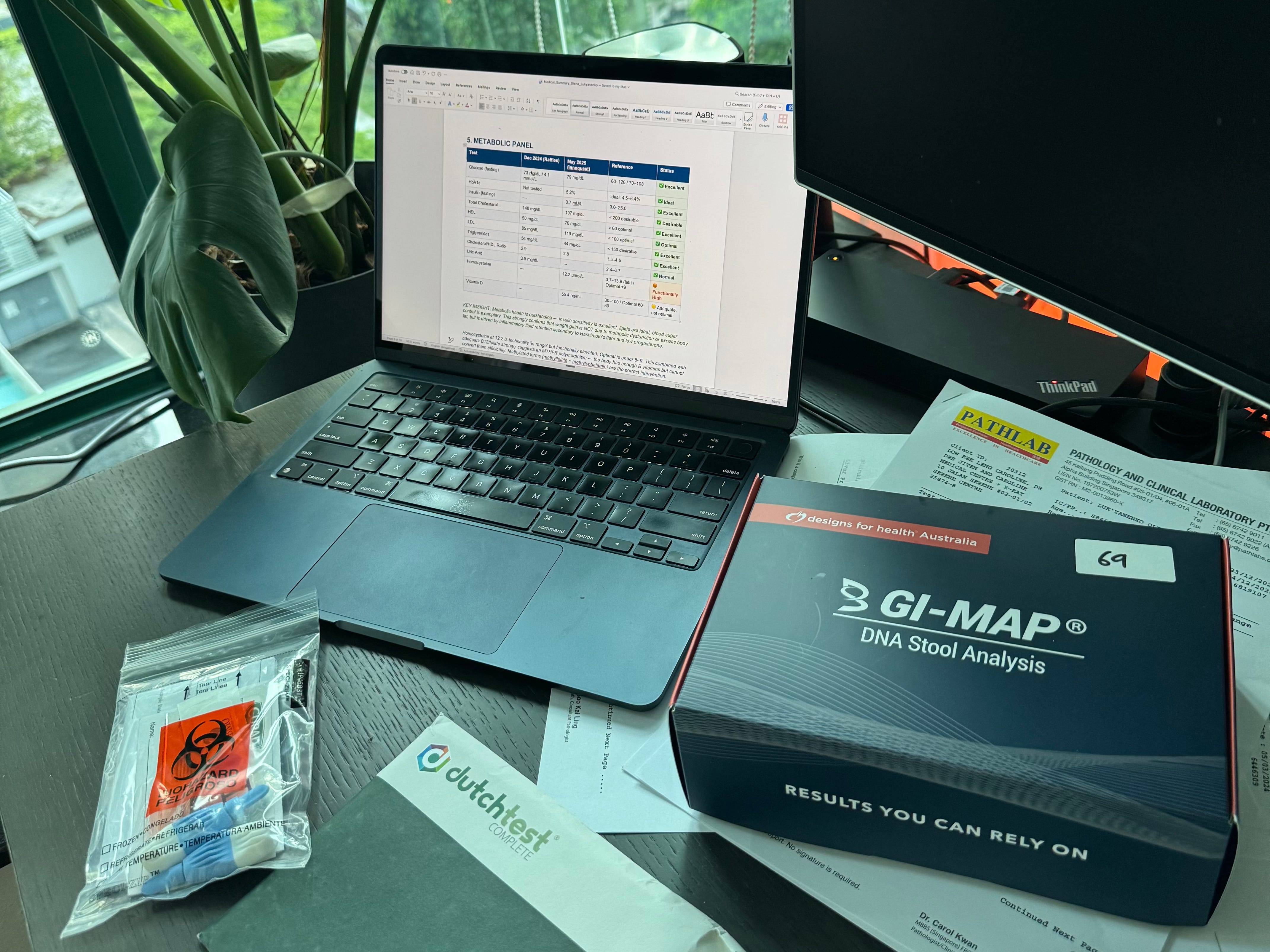
The three tests worth knowing about
If anything in the description above resonates — unexplained weight changes despite clean habits, a mood that doesn’t match your circumstances, energy that doesn’t respond to adequate rest, an immune system that seems slow to recover, or digestive patterns that feel inconsistent — there are three assessments that go meaningfully beyond what a standard panel can show.
GI MAP (Gastrointestinal Microbial Assay Plus) is a stool test that maps the specific organisms present in your gut across bacterial, parasitic, and fungal categories. It identifies pathogens, measures the ratio of beneficial to harmful bacteria, and flags markers of intestinal inflammation and permeability. In practical terms, it gives you a detailed picture of what is actually living in your microbiome — and what should be there but isn’t.
DUTCH Complete (Dried Urine Test for Comprehensive Hormones) goes beyond measuring hormone levels to show how your body actually metabolises them, and — crucially — how your cortisol behaves across the full arc of a day. A standard blood test captures cortisol at a single point in time, which can look entirely normal even when the daily pattern is significantly disrupted. The DUTCH reveals that pattern, and that is where the clinically meaningful information tends to live.
Food Sensitivity Testing (IgG panel) measures delayed immune responses to specific foods, the kind of reactions that unfold hours after eating rather than immediately, and which can sustain low-grade inflammation without producing any obvious or traceable symptoms. For people who are eating carefully and still carrying markers of inflammation, this test frequently reveals the missing piece.
All three need to be ordered and interpreted by a functional medicine or integrative medicine practitioner. The interpretation is where the value of the testing actually lives, since the results only become actionable when read in the context of the full clinical picture.
Finding the right practitioner
A conventional doctor working within a standard healthcare framework is trained to diagnose and treat disease, and does that work well. A functional medicine or integrative medicine practitioner is working from a different question: what does optimal function look like for this individual, and what is standing in the way of it? Both are legitimate and valuable, but they are built for different purposes.
When you’re evaluating a potential functional medicine practitioner, it’s worth asking directly whether they use GI MAP and DUTCH testing in their practice, how they approach gut healing protocols, and what their framework looks like for root cause investigation versus symptom management. How a practitioner responds to those questions will tell you fairly quickly whether their approach matches what you’re looking for. Functional medicine is increasingly accessible across Singapore and major cities in Asia, and it’s worth approaching the search with the same care and due diligence you’d bring to finding the right advisor for any other high-stakes decision.
The leadership instinct that works against you here
High performers develop a particular relationship with discomfort over time: push through it, manage it, keep moving. Something feels off? It’s probably stress, probably a phase, probably something that discipline and rest will eventually resolve. That instinct is genuinely useful in many situations. Applied to your own biology, it can keep you from hearing a signal that is worth paying attention to.
The gut communicates in ways that are easy to rationalise away — a mood that stays flat longer than it should, a body that isn’t responding to effort the way it once did, an energy level that doesn’t seem to correlate with how much you sleep. They are the body’s way of flagging that something in the underlying system needs attention.
The leaders who maintain high performance across decades are the ones who have learned to treat their body with the same analytical rigour they bring to the systems they manage professionally. When outputs are consistently inconsistent despite doing everything right, the right response is not to add more inputs. It is to examine the system producing those outputs, and ask honestly what you might be missing.
Where to start
If you’ve been experiencing a combination of any of the above for more than a few months, the most useful next step is a consultation with a functional medicine practitioner. Bring a full picture of your symptoms, including those that feel vague and hard to explain. Ask specifically about GI MAP, DUTCH Complete, and food sensitivity testing, and pay attention to whether the conversation feels like an investigation or a prescription.
And if you’re not ready for that yet, start with the simpler question: Am I actually treating the root cause of what I’m experiencing, or am I managing how it shows up?
That question, sat with honestly, is usually where real change begins.
A quick question before you go:
If you'd like to share what came up for you reading this, whether it's your own experience, a question, or simply that it resonated, drop a comment below. I read every message.
For more strategies on vitality, growth, leadership, and innovation, subscribe to my weekly letter, The Graceful Edge, where ambitious leaders gain a competitive advantage. Free to read. Subscribe below.